
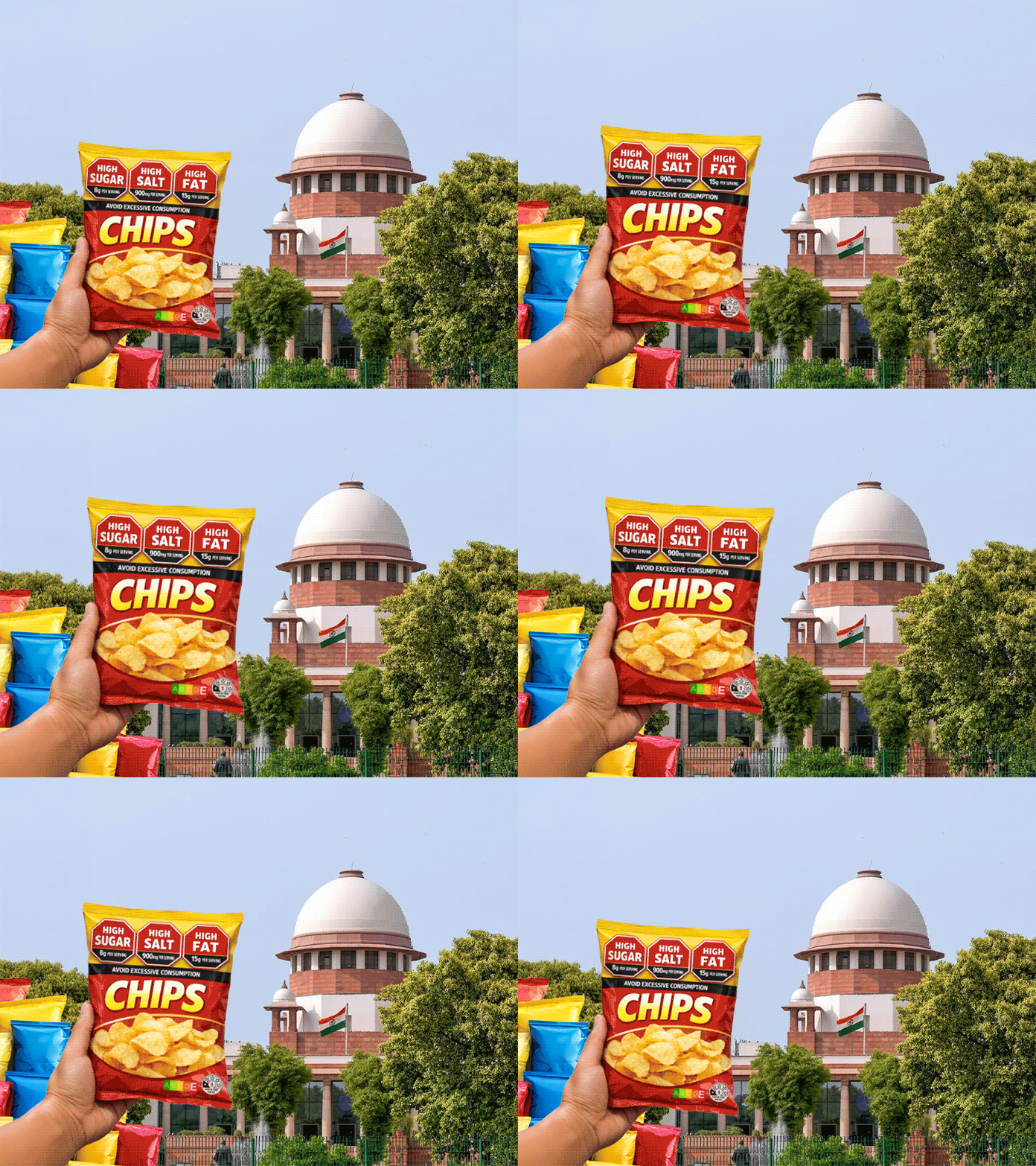
We often buy a packet of chips, cookies, or namkeen and eat it. Very few people turn the packet around to check the nutritional value of the food they are consuming. How much sugar, salt, or fat it contains. The information written on the packet tells us how healthy or unhealthy the food is.
But if this information is written on the front of the packet in an easy way with colours and graphics, then we can understand it at a single glance. It will also become easier for us to choose healthy food. This is called ‘Front-of-Pack Labelling.’
Recently, the Supreme Court has given an important direction to FSSAI (Food Safety and Standards Authority of India) and the central government. The Court has said that the implementation of “front-of-pack warning labels” on packaged food should be considered.
This label will display essential information on the front of the packet so that consumers can know before buying how much sugar, salt, and fat it contains.
So today in Need to Know, we will understand:
What is Front-of-Pack Labelling?
Why is front-of-pack labeling necessary?
How can it help reduce the risk of serious diseases?
Expert: Dr. Narendra Kumar Singla, Principal Consultant, Internal Medicine, Sri Balaji Action Medical Institute, Delhi
What is ‘Front of Pack Labelling’? Front-of-Pack Labelling (FOPL) is a label written on the front part of a food product packet. It shows information about the main ingredients, like sugar, salt, and fat, in an easy and quick-to-understand way.
Its purpose is that the customer can immediately understand how healthy the food they are buying is. It is different from the long nutrition facts written on the back of the packet. It shows only essential information through simple graphics or colours.
Where is nutritional information written on current packaged food? It is usually written on the back or side of the packaged food in the form of a table. This information shows the nutritional value per 100 grams, 100 milliliters, or per serving, such as calories, fat, protein, sugar, and sodium.
What does ‘Front of Pack Labelling’ indicate? Front-of-pack labeling indicates whether the food is healthy or unhealthy. How many calories, sugar, salt and fat it contains and whether it can pose a health risk. See details in the graphic below–
Why is ‘Front of Pack Labelling’ necessary? Front of Pack Labelling is necessary so that people can quickly and clearly understand the health impact of packaged food while buying it. It will make it easier for them to choose healthy options and prevent excessive consumption of unhealthy food.
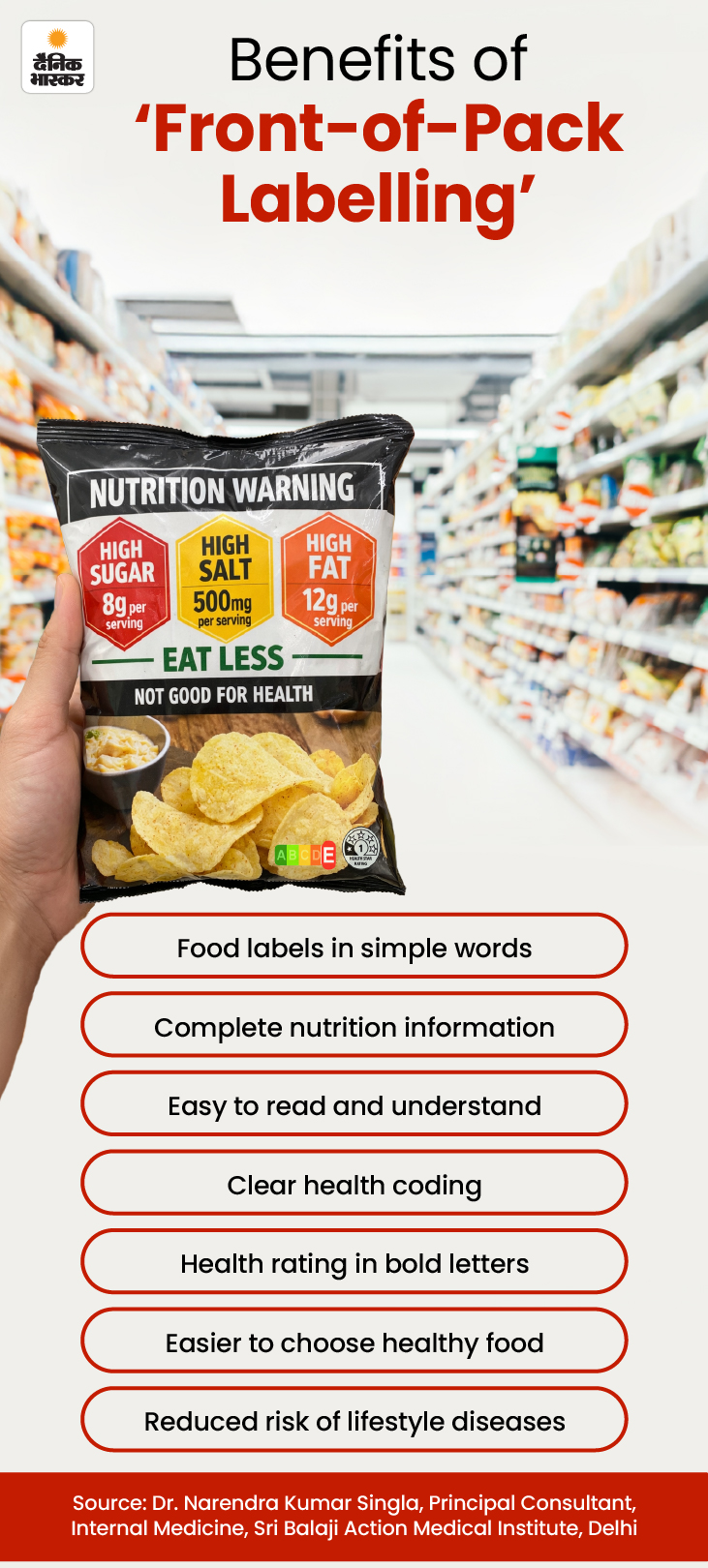
What benefits will we get from ‘Front of Pack Labelling’? The purpose of Front of Pack Labelling is to simplify complex nutrition information so that customers can make better decisions at the time of purchase and avoid unhealthy options. See the benefits in the graphic below–
What impact will ‘Front of Pack Labelling’ have on people’s health? By reading the nutritional value, people will be able to decide how healthy the food is for them. It can also reduce the risk of many serious diseases such as obesity, diabetes, and heart disease. It will promote healthy eating habits. See the impact on health in the graphic below–
Why has the Supreme Court directed FSSAI to consider implementing ‘Front of Pack Labelling’ on every packaged food item? Lifestyle diseases are increasing rapidly in the country. A major reason for this is unhealthy eating habits. The high amount of sugar, salt and fat present in packaged and ultra-processed food is a major cause of these diseases.
Considering this serious situation, the Supreme Court has asked FSSAI to seriously consider implementing ‘Front of Pack Labelling’ on packaged food so that people can understand potential health risks at the time of purchase.
How will ‘Front of Pack Labelling’ help in identifying how healthy a packaged food is? Front-of-pack labeling works like a health grading of food. For example, a ‘High Sugar’ label warns you that this food is not healthy for frequent consumption.
Similarly, a ‘Low Fat/Low Salt’ sign helps in choosing healthier options. In this way, at a single glance, the customer understands whether a packaged food is safe, balanced, or risky for health.
In many countries, Front of Pack Labelling is shown in three different colours. Food with high salt, sugar, and fat has a red label, and food with lower amounts has a green label.
In this way, without reading nutrition details, people can identify whether the food is healthy or unhealthy just by looking at the colour. They can blindly buy green label food or decide to eat red label food only once or twice a month.
Can this labelling help reduce the risk of diseases like obesity, diabetes and high BP? Labelling only helps in creating awareness. It does not guarantee that serious diseases will not occur. Labelling will only tell us that the food is unhealthy, but if we still consume it, we are increasing the risk of diseases. It can be said that whatever decision people make, it will be an informed decision.
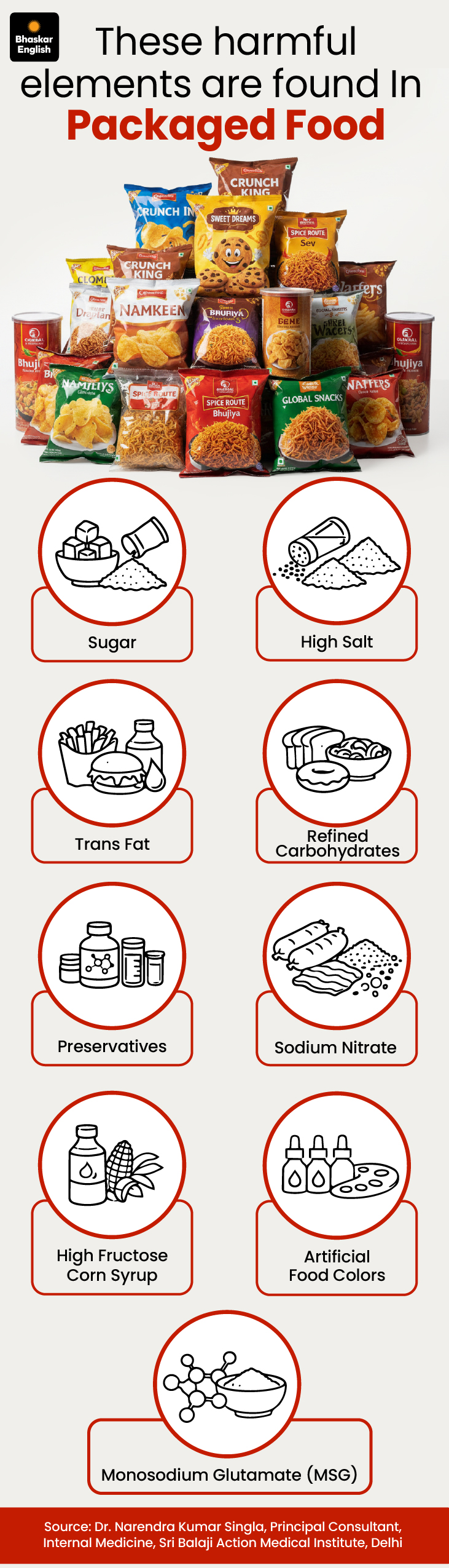
What are the elements in packaged food that are most harmful to health? Not every packaged food is harmful, but some elements can be dangerous for the body if consumed in excess.
- High salt
- Trans fat
- Refined carbs
- Preservatives
- Artificial food colour
- High fructose corn syrup
- Sodium nitrate
- Monosodium glutamate
How much packaged food is safe to consume? Packaged food should be consumed in limited quantity. It can be taken once a month or on special occasions.
What are the healthy options instead of packaged food? Instead of packaged and processed food, it is better to choose options that are less processed, natural and rich in nutrients. Understand from the pointers–
- Eat fresh fruits and green vegetables.
- Eat unsalted nuts and seeds.
- Eat whole grains.
- Eat home-cooked food.
These options provide the body with essential vitamins, fibre and minerals. They also protect from extra sugar, sodium and trans fat.
Source link
March is National Nutrition Month, Sleep Month and Daylight Savings Time begins, plus EPI-Lifestyle 2026 and more…
Healthy eating after 45 may add years to your life, study finds
Do You Have a Healthy Relationship With Food?